



Table of Contents
Share At:




Listen Article:
0:00 /
0:00
How Does a Dialyzer for Hemodialysis Work and What’s the Difference Between High-Flux and Low Flux Types?
Table of Contents
Hemodialysis is a medical procedure used to treat patients with kidney failure. It involves filtering waste, excess fluids, and toxins from the bloodstream when the kidneys can no longer perform their natural function. The device responsible for this filtration is called a dialyser. Understanding how a dialyser works, the difference between high-flux and low-flux types, and which type suits specific patient conditions is essential for effective treatment.
What is a Dialyzer and Its Role in Hemodialysis?
A dialyzer, often referred to as the “artificial kidney,” is a device used in hemodialysis to remove waste, toxins, and excess fluid from the blood. It is a critical component in the dialysis machine, acting as a filter to mimic the kidney’s natural function.
The dialyzer contains a semi-permeable membrane that separates the patient’s blood from a special dialysate fluid. This membrane allows waste products and excess fluid to pass through while preventing essential substances like blood cells and proteins from being lost. The clean blood is then returned to the patient’s body, completing the dialysis cycle.
Proven Dialysis Solutions. Trusted by Clinics
 WHATSAPP NOW
How Does a Dialyzer Filter Toxins and Excess Fluids?
The dialyzer functions through a process called diffusion and ultrafiltration:
- Diffusion: Blood flows through one side of the dialyser’s semi-permeable membrane, while a special dialysate (a sterile fluid) flows on the other side. Toxins, waste products, and excess fluids from the blood pass through the membrane and into the dialysate. The process is driven by concentration gradients — waste in the blood moves to where it is less concentrated in the dialysate.
- Ultrafiltration: This is the process where excess water (fluid) is removed from the blood by applying a pressure gradient across the dialyser membrane. The fluid is drawn from the blood and into the dialysate. This ensures that the patient’s fluid balance is maintained.
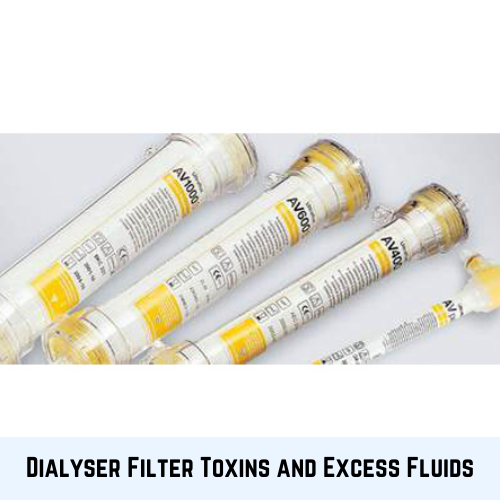
The result is the purification of the blood, removing harmful substances and excess fluids that would otherwise accumulate in the body.
What is the Difference Between High Flux and Low Flux Dialyzers?
Dialyzers are categorized into high flux and low flux types based on the permeability of their membranes. The permeability determines how efficiently the dialyser can filter blood and remove waste and fluids.
Low Flux Dialyzers:
- Membrane Characteristics: Low flux dialyzers have a membrane with smaller pores, limiting their ability to filter larger molecules.
- Filtration Capability: These dialysers are typically used for removing smaller toxins and fluids from the blood, making them suitable for patients who do not require extensive toxin removal.
- Usage: Low-flux dialysers are typically used in standard hemodialysis treatments for patients with relatively stable kidney function or for those who do not require high toxin clearance.
High Flux Dialyzers:
- Membrane Characteristics: High flux dialyzers have larger pores in the membrane, allowing them to remove larger molecules such as middle molecules (which are typically harder to clear).
- Filtration Capability: These dialysers are capable of clearing both small and larger molecules, making them ideal for patients who have a higher level of toxin buildup or fluid retention. They also have enhanced ability to filter out more fluid from the bloodstream.
- Usage: High-flux dialysers are used in cases where rapid toxin removal is necessary, or when patients have specific conditions like uremic toxins that require more aggressive treatment.
Which Type is Better for Specific Patient Conditions?
Choosing between high flux and low flux dialyzers depends on the patient’s individual needs, including the severity of kidney failure and the presence of other complications.
- Low Flux Dialysers: Best for stable patients with early-stage kidney failure or those who require routine dialysis. These dialysers are effective for maintaining fluid balance and removing smaller waste products, but they may not be sufficient for patients with advanced kidney disease or large toxin loads.
- High Flux Dialysers: Ideal for patients with advanced kidney disease or end-stage renal failure, particularly when the patient’s body retains large amounts of fluid or has accumulated middle molecules. These dialysers are often recommended for patients who require more aggressive toxin removal or have complicated medical conditions (e.g., diabetes, heart disease) that lead to the buildup of more complex waste products.
High flux dialyzers are also suitable for hemodiafiltration treatments, where both diffusion and convection (the movement of fluid and solutes) are used to clear toxins more efficiently.
How Do Dialyzers Impact Treatment Time and Efficiency?
The type of dialyzer used can impact both the duration and efficiency of dialysis treatment:
- Low Flux Dialyzers: Since low flux dialyzers are less permeable, they take longer dialysis sessions to effectively clear the necessary toxins and fluids. These dialysers are generally less efficient than high-flux dialysers, and patients may require multiple sessions per week to maintain an appropriate toxin and fluid balance.
- High Flux Dialyzers: Designed for high-efficiency hemodialysis therapy, high flux dialyzers, due to their greater permeability, allow for faster filtration, which can reduce dialysis time and improve overall treatment efficiency. These dialysers remove waste and excess fluid more effectively, and patients can experience shorter treatment times. For patients who have accumulated large amounts of waste products, high-flux dialysers allow for more complete toxin removal in a shorter time.
-
Additionally, high flux dialyzers can improve patient comfort, as they reduce the risk of fluid overload and related complications, allowing for better control over the dialysis process.
The Complete Range of Dialysis Consumables
TALK TO OUR EXPERTS Conclusion
The dialyzer is an essential component of hemodialysis, and understanding its role in filtering toxins and excess fluid from the blood is critical for both healthcare providers and patients. The difference between high flux and low flux dialyzers lies primarily in their membrane permeability, which affects the efficiency and speed of dialysis treatments.
- Low flux dialyzers are ideal for patients with early kidney disease or those requiring routine dialysis treatments.
- High flux dialyzers are better suited for patients with advanced kidney disease or those needing rapid toxin removal.
Ultimately, the choice between these dialyser types should be made based on the patient’s medical condition, treatment goals, and individual needs. By selecting the appropriate dialyser, healthcare providers can optimize the dialysis process, ensuring that patients receive the most effective treatment for their kidney health.
FAQs on Dialyzer
To determine the best type of dialyzer for your treatment, it is essential to consider factors such as the stage of your kidney disease, your overall health, and any additional medical conditions. High-flux dialyzers are recommended for patients with advanced kidney disease or those requiring aggressive toxin removal, while low-flux dialyzers are typically used for more stable patients with fewer complications. Your healthcare provider will assess your individual needs to select the most suitable dialyzer for effective treatment.
Yes, Nephroxa dialyzers are versatile and can be used for both hemodialysis and hemodiafiltration. Hemodiafiltration, which combines diffusion and convection, is ideal for patients with high toxin buildup. Nephroxa’s high-flux dialyzers are designed to facilitate this advanced treatment by ensuring more efficient removal of toxins and excess fluid, providing optimal outcomes for patients with complex renal conditions.
Nephroxa dialyzers are engineered with safety features such as biocompatible materials, kink-resistant tubing, and air-exclusion filters, which help reduce the risk of complications like blood clots, air embolism, and infection. These features ensure a smoother dialysis experience, reducing the chances of treatment interruptions and enhancing patient comfort during the procedure.
The membrane material used in dialyzers plays a crucial role in patient comfort during dialysis. Biocompatible materials used in Nephroxa dialyzers help reduce inflammatory responses and allergic reactions that could cause discomfort or other adverse effects. These materials ensure that the dialyzer is well-tolerated by the body, improving overall patient experience during treatment.
Nephroxa high flux dialyzers are designed to provide faster filtration, allowing for shorter dialysis sessions without compromising on the effectiveness of the treatment. With their advanced filtration technology, Nephroxa dialyzers efficiently remove toxins and excess fluid from the blood, reducing treatment times and improving the efficiency of the dialysis process, which is crucial for patient comfort and healthcare facility productivity.



