



Table of Contents
Share At:




Listen Article:
0:00 /
0:00
How Nephroxa’s Modern Dialysis Chairs are Redefining Treatment Comfort for Patients?
Table of Contents
Objective
The objective of this article is to explore and explain how Nephroxa’s modern dialysis chairs are transforming the comfort levels experienced by patients undergoing dialysis treatment. This article will examine the technical innovations, ergonomic advancements and patient-centric design principles that place Nephroxa at the forefront of dialysis chair solutions.
How Nephroxa's Modern Dialysis Chairs are Redefining Treatment Comfort for Patients?
- Bicart Cartridge: The Bicart cartridge is stored in a compact, sealed unit with a longer shelf life, providing a more convenient solution for dialysis centers.
- Liquid Bicarbonate: Liquid bicarbonate concentrate needs to be stored properly to maintain its effectiveness and prevent contamination. The shelf life may be shorter and requires temperature control.
Hospitals Choose NEPHROXA.
Shouldn’t You?
GET IN TOUCH
How does Nephroxa optimize ergonomic support in its dialysis chairs?
Ergonomics in medical furniture design is about fitting the equipment to the user – in this case, the dialysis patient. A dialysis chair must not only offer posture support but also accommodate variations in patient height, weight and health condition. Nephroxa chairs address this challenge through adjustable mechanisms that allow personalization of seat height, backrest angle and leg support.
The chairs feature smooth motorized adjustments, controlled by an intuitive electronic handset. This remote control allows caregivers or patients themselves to reposition the chair easily, even mid-treatment. The reclining system helps distribute body weight evenly, reducing pressure on specific points like the lower back or thighs, which may otherwise cause numbness or discomfort.
Moreover, the inclusion of memory foam padding, breathable fabric and anti-bacterial coatings ensures both comfort and hygiene. This kind of thoughtful material selection shows how Nephroxa’s medical dialysis chair design is not just technical but also patient-sensitive.
From the neck to the ankles, every part of the body finds support in the Nephroxa chair’s structure. Even patients with limited mobility may feel secure due to the side support and non-slip armrests. In high-risk settings like dialysis centers, where patient frailty is a common concern, this level of ergonomic customization is a breakthrough.
How do safety and power management features enhance patient experience?
Safety features in medical furniture often go unnoticed – until they fail. Nephroxa takes a proactive approach by embedding intelligent safety features directly into its chairs. A prominent example is the control box power-saving function. When the electronic handset is inactive, the chair automatically cuts power to conserve energy and reduce risk of electric hazards.
This innovation does more than save electricity – it eliminates unnecessary heat or current from circulating in the system, which may prevent short circuits or accidental malfunctions. For facilities handling multiple dialysis sessions daily, such reliability becomes a cornerstone of operational safety.
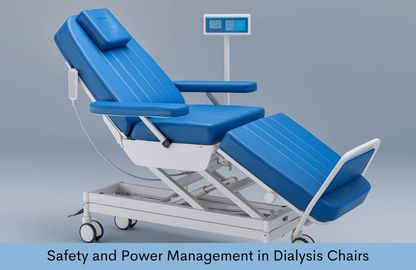
Also notable are the lockable wheels, patient weight-bearing capacity and anti-tilt design. These are not afterthoughts but core to how Nephroxa’s dialysis treatment chair ensures both mobility and stability. Care teams can easily move the chair when required, yet anchor it firmly during treatment.
From an infection control standpoint, the chair’s surface is easy to sanitize and resistant to fluid absorption. Medical-grade vinyls and sealed seams help prevent contamination, a must in environments prone to blood or fluid exposure. Collectively, these design elements redefine what it means to create a “safe” treatment chair.
In what ways do Nephroxa Chairs enhance operational efficiency for clinics?
While the patient’s comfort is paramount, clinic staff also benefit from the functional aspects of the Nephroxa dialysis chair. An intuitive handset and motorized adjustment reduce the manual effort needed to position patients, which may decrease caregiver fatigue and increase productivity.
The modular design of the Nephroxa Chair allows for quick maintenance. If a part needs servicing, it may be removed or replaced without disassembling the entire chair. This translates to less downtime and uninterrupted patient care, which is vital in high-traffic medical facilities.
Additionally, the chairs are compact yet spacious, occupying minimal floor area while offering maximal seating comfort. This balance between form and function means that dialysis centers can place more chairs within a given space without sacrificing accessibility.
Operational efficiency also improves through features like side trays for equipment placement, pole attachments and power outlets for patient devices. These integrations help streamline treatment delivery and reduce clutter. As a result, clinics may notice not only smoother workflows but also increased patient satisfaction, as the environment appears more organized and patient-oriented.
How is the design philosophy behind Nephroxa redefining treatment standards?
Nephroxa doesn’t treat the dialysis chair as a static piece of equipment – it sees it as an extension of patient care. The brand’s design philosophy centers on human-centric engineering, where form follows function but never compromises on compassion.
Every adjustment points on the chair, from back recline to leg raise, serves a medical purpose. Even features like cup holders or document trays are integrated to reflect actual patient needs during long treatment sessions. This synthesis of thoughtful design and technical performance is what distinguishes Nephroxa Chair from conventional models.
Rather than following trends, the chairs are developed through collaboration with clinicians, biomedical engineers and even dialysis patients themselves. This feedback loop allows Nephroxa to fine-tune its offerings to match the evolving standards of care.
Moreover, as healthcare shifts toward outpatient and home-based dialysis, the versatility of Nephroxa chairs becomes more relevant. These chairs may be adapted to different settings without compromising comfort or safety, ensuring consistency in care regardless of the environment.
In essence, the Nephroxa Dialysis Chair doesn’t just provide a place to sit – it establishes a new standard for how medical seating can enhance the treatment journey.
Shubham Corporation – Living Dialysis
Delivering Trust
 EMAIL OUR EXPERTS
In Conclusion
Nephroxa’s modern dialysis chairs are not merely updates to traditional models – they represent a reimagining of what patient-centered treatment should feel like. Through a combination of ergonomic design, safety integrations, operational efficiency and thoughtful functionality, Nephroxa chairs may significantly improve both the clinical and emotional experience of dialysis.
While the challenges of dialysis remain, the way patients face those challenges is evolving. With medical furniture like the Nephroxa dialysis chair, comfort becomes part of the care plan. It’s not an add-on, but a necessity – carefully engineered into every curve, switch and cushion of the chair.
FAQs About Dialysis Chairs
A Nephroxa Dialysis Chair is a specialized medical chair designed to offer comfort and support to patients undergoing dialysis treatment. It features ergonomic adjustments, power-saving functions and high-grade materials to improve the treatment experience.
Dialysis chairs are built specifically for medical use. They support long-duration sitting, provide adjustable positions and meet hygiene and safety standards. Regular recliners do not offer such clinical features.
Yes, the Nephroxa Chair may be suitable for home-based dialysis due to its compact design, easy-to-use controls and patient-friendly features.
The chair automatically cuts off power to the electronic controls when the handset is not in use, which conserves energy and reduces risks of overheating or electrical faults.
Dialysis chair price may vary depending on model, features and regional availability. It’s recommended to contact medical equipment suppliers for an accurate quote.



