



Table of Contents
Share At:




Listen Article:
0:00 /
0:00
Which Catheter is Right for Hemodialysis? Dual Lumen vs. Standard Haemodialysis Catheters
Table of Contents
Hemodialysis is a life-sustaining therapy for patients with end-stage renal disease and the efficiency of the procedure depends largely on the quality and suitability of vascular access. Among the vascular access options available, dialysis catheters are frequently used for both short-term and long-term dialysis treatments. Choosing the right catheter is not a trivial decision. It can directly influence patient outcomes, dialysis adequacy, complication rates and overall treatment success.
The two most commonly used types of dialysis catheters are dual lumen dialysis catheters and standard haemodialysis catheters. While they may serve the same basic purpose – allowing blood to flow out of and back into the patient’s body during dialysis – they differ significantly in design, performance and clinical application.
In this article, we’ll explore the key differences between dual lumen and standard haemodialysis catheters. We will examine their structures, use cases, benefits, limitations and how to determine the most appropriate option for each patient. We’ll also highlight that Shubham Corporation, as a reliable manufacturers and suppliers, play a pivotal role in providing high-quality dialysis consumables that meet modern healthcare standards.
Exclusive Dialysis Products for Your Hospital
CONNECT TODAY
Understanding Hemodialysis Catheters
Hemodialysis catheters are often the starting point when dialysis is first initiated, especially in emergency situations. These catheters are typically non-tunneled, straight in design and constructed for short-term vascular access. A standard hemodialysis catheter features two distinct lumens – an arterial lumen to withdraw blood and a venous lumen to return it – although the overall structure may be less advanced compared to specialized dual lumen catheters.
These catheters are inserted into large central veins, commonly the internal jugular, subclavian or femoral veins. Their relatively simple design makes them easier and faster to insert, which is advantageous in acute clinical settings. However, their simplicity can also introduce certain limitations, particularly in terms of performance and patient comfort.
One of the main drawbacks of standard hemodialysis catheters is the increased risk of recirculation. This occurs when blood that has already been filtered re-enters the arterial lumen, reducing the overall efficiency of the dialysis treatment. Furthermore, their tip design often lacks advanced engineering features to optimize blood flow dynamics, potentially resulting in clot formation, poor flow rates or mechanical complications.
Despite these limitations, standard catheters are widely used due to their accessibility, cost-effectiveness and adequate functionality for short-term dialysis. They are an essential part of nephrology practice and remain a viable option when immediate dialysis is required or when other access points are unavailable.
What Is a Dual Lumen Dialysis Catheter?
The dialysis dual lumen catheter, often referred to as a double lumen dialysis catheter, is a more advanced solution designed specifically to overcome the limitations of standard catheters. As the name suggests, it comprises two separate lumens – housed within a single catheter body – that serve independent functions: one lumen draws blood from the patient, while the other returns the cleaned blood after filtration through the dialysis machine.
What sets the dual lumen catheter apart is its engineered design that optimizes blood flow, minimizes recirculation and enhances dialysis efficiency. These catheters are typically made from high-grade biocompatible materials like polyurethane, silicone or other medical-grade polymers. They may feature soft, flexible tips, curved shapes and cuffed tunneled designs for long-term use. Some designs include split tips or symmetric tip technology to ensure smoother blood dynamics and minimize resistance during blood exchange.
The dual lumen catheter is ideal for patients who require medium to long-term dialysis but have no viable arteriovenous fistula or graft. It can also be used as a bridge while waiting for permanent vascular access to mature. Due to its design advantages, it allows for higher flow rates – which significantly enhances the efficacy of dialysis sessions.
These catheters are also available in multiple sizes and shapes to accommodate different patient anatomies and insertion techniques. In clinical practice, dual lumen catheters are widely regarded as the preferred choice for reliable, high-performance vascular access, especially when patient safety, comfort and treatment efficiency are paramount.
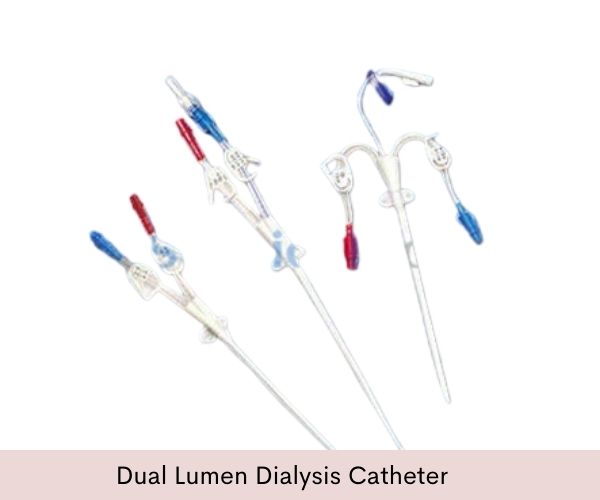
Comparing Key Features: Dual Lumen vs. Hemodialysis Catheters
When deciding between a dual lumen dialysis catheter and a standard haemodialysis catheter, understanding the core differences in structure and function is crucial. Below is a comprehensive comparison of the two types:
- Lumen Configuration: Both catheters have two lumens, but dual lumen catheters are engineered to keep the lumens separated and optimized for flow, reducing recirculation risks. Standard catheters often have less sophisticated lumen separation, leading to suboptimal performance.
- Flow Rate: Dual lumen catheters allow for higher and more consistent blood flow, making them ideal for prolonged and effective dialysis treatments. Standard catheters may experience reduced flow rates due to design limitations.
- Insertion Duration: Standard catheters are more suited for temporary use – generally up to three weeks – while dual lumen catheters, especially those that are tunneled and cuffed, can remain in place for months if cared for properly.
- Tip Design: Advanced dual lumen catheters feature specialized tips to reduce turbulence and prevent clot formation. Standard catheters usually have basic tip designs with side holes that may contribute to thrombus accumulation.
- Patient Comfort: Due to their material flexibility and tunneled design, dual lumen catheters offer better long-term comfort. Standard catheters, while easier to insert, can be less comfortable over time.
- Infection Risk: Tunnelled dual lumen catheters with antimicrobial coatings or cuffs have a lower risk of infection compared to non-tunnelled standard catheters, which are more exposed to external pathogens.
When to Choose Each: Clinical Use Cases
Use a Standard Hemodialysis Catheter When
- The need for dialysis is urgent and quick vascular access is essential.
- Dialysis is expected to last only a few days or weeks.
- The patient is awaiting surgical placement of a more permanent vascular access (e.g., AV fistula or graft).
- Budget or supply limitations restrict access to advanced catheter designs.
Use a Dual Lumen Dialysis Catheter When
- The patient requires ongoing dialysis over weeks to months.
- A high-flow, low-recirculation access is essential for treatment efficiency.
- Previous access sites have failed and alternative access is limited.
- The catheter will be managed in a home dialysis or outpatient setting requiring comfort and durability.
Material Composition and Design Considerations
Modern catheter are designed with patient safety, clinical performance and durability in mind. Materials used in dual lumen catheters often include:
- Polyurethane: Offers strength with flexibility, suitable for high-flow applications.
- Silicone: Biocompatible and softer, making it more comfortable for long-term use.
- Latex-free compounds: Ideal for patients with allergies.
In addition, the presence of a Dacron cuff in tunneled catheters helps reduce infection risk by encouraging tissue ingrowth that secures the catheter and acts as a microbial barrier.
Catheter kits for dialysis now come with everything required for insertion: dilators, guidewires, clamps and flushing caps – ensuring that the catheter is inserted with maximum sterility and precision.
Shubham Corporation: Leading Manufacturer and Supplier of Dialysis Catheters
Shubham Corporation stands out as a reliable dialysis catheter manufacturer, supplier and exporter, providing an extensive range of high-quality dialysis consumables. Its Dialysis Dual Lumen Catheters are manufactured with precision using medical-grade materials to ensure patient safety, optimal flow and long-term durability.
Shubham Corporation offers catheter kits for dialysis treatments in various sizes and configurations – including small, medium, large and extra-large – to match patient needs. Their haemodialysis catheters feature advanced tip designs that reduce recirculation, maintain continuous blood flow and enhance treatment outcomes.
Whether you are a healthcare provider, hospital or dialysis center, choosing a dependable partner like Shubham Corporation ensures consistent supply, reliable performance and patient satisfaction.
Shubham Corporation - Living Dialysis, Delivering Trust
 EMAIL OUR EXPERTS
Conclusion
Selecting the right catheter for hemodialysis is more than a procedural choice – it’s a clinical decision that can influence patient outcomes for weeks or months. While standard haemodialysis catheters serve an essential role in emergency or short-term care, the dual lumen dialysis catheter offers clear advantages in terms of flow, comfort and long-term usability.
Clinicians should weigh the duration of therapy, patient anatomy, infection risk and dialysis goals before making the final choice. Working with trusted catheter manufacturers and suppliers like Shubham Corporation ensures that the chosen solution is both clinically effective and logistically dependable.
FAQs About Haemodialysis Catheters
Dual lumen catheters are designed for higher flow and lower recirculation, making them suitable for long-term dialysis. Standard catheters are simpler, often non-tunnelled and used for short-term access.
Dual lumen catheters, especially tunneled and cuffed versions, can be used for several months if maintained properly, though arteriovenous fistulas remain the gold standard for long-term access.
Medical-grade polyurethane and silicone are commonly used. They provide the right balance between flexibility, strength and biocompatibility.
Yes. Dual lumen catheters with tunneled designs and antimicrobial features generally present a lower risk of infection compared to non-tunnelled standard catheters.
Shubham Corporation is a trusted manufacturer and supplier of dialysis catheters, including dual lumen, standard and complete catheter kits.



