



Table of Contents
Share At:




Listen Article:
0:00 /
0:00
Why Hospitals are Switching to Nephroxa Dialyzers for Better Hemodialysis Outcomes?
Table of Contents
Objective
This article explains why hospitals are shifting to Nephroxa dialyzers to achieve better outcomes in hemodialysis treatments. It focuses on the functional performance, operational compatibility and clinical implications of adopting Nephroxa dialyzer medical devices, including variants such as high flux dialyzers, low flux dialyzers and whether they support single use or reuse dialyzer protocols. The discussion centers around improving dialyzer efficiency and practical suitability in modern hospital settings.
What Is a Dialyzer and How Is It Classified in Medical Practice?
A dialyzer medical device, often called an hemodialyzer, is a core component in hemodialysis systems. It acts as a filter where blood is passed through a semi-permeable membrane to remove toxins, waste products and excess fluids.
Dialyzers are broadly classified by:
Flux Type:
- Low flux dialyzer: Designed for small solute removal, suitable for standard toxin clearance.
- High flux dialyzer: Capable of removing both small and larger molecules, offering broader detoxification.
Usage Type:
- Single use dialyzer: Discarded after one treatment session to eliminate contamination risks.
- Reuse dialyzer: Cleaned and sterilized for multiple uses under strict guidelines.
In hospital environments, the choice between these types directly affects efficiency, cost and patient safety, making the selection of an appropriate dialyzer unit a critical decision.
Shubham Corporation – Living Dialysis,
Delivering Trust
 EMAIL OUR EXPERTS
Why Are Hospitals Transitioning to Nephroxa Dialyzer Devices?
Hospitals are not simply looking for any dialyzer device; they require systems that align with evolving clinical expectations. The transition to Nephroxa is largely driven by the need for reliability, integration and efficient outcomes.
Nephroxa dialyzers are engineered to support modern dialysis techniques with an emphasis on performance. Their design may enhance solute clearance, ensure membrane stability and minimize performance variability across sessions.
Moreover, when hospitals use multiple products under one system – from concentrates to dialyzer units – interoperability matters. The adoption of Nephroxa supports a seamless interface between components, which can reduce technical errors and improve overall treatment consistency.
This system-wide integration may streamline operational tasks such as calibration, monitoring and equipment maintenance. Hospitals making the switch often seek these process efficiencies alongside clinical improvements.
How Nephroxa Dialyzers Available in Both High Flux and Low Flux Options?
Hospitals must tailor their hemodialyzer choices based on patient requirements. Some individuals benefit from low flux clearance, while others need the more advanced removal capabilities of high flux membranes.
Nephroxa appears to offer models that support both configurations. In cases requiring more aggressive toxin removal – especially for larger or protein-bound molecules – a high flux dialyzer may be preferred. These types may help manage patients with chronic inflammation or longer dialysis vintage.
On the other hand, patients who are hemodynamically stable or undergoing standard dialysis sessions may be treated using a low flux dialyzer where precision and consistency are prioritized over volume clearance.
The versatility of Nephroxa in supporting both options provides hospitals with flexibility in treatment planning. If the same brand can accommodate diverse clinical cases without compromising performance, it makes sense for hospitals to consolidate around that brand.
Why the Nephroxa Dialyzer Support Single-Use and Reuse Protocols?
The choice between single use and reuse dialyzer practices impacts both operational logistics and clinical outcomes. Many hospitals are re-evaluating reuse policies due to the challenges in maintaining membrane integrity, consistent performance and infection control.
Nephroxa dialyzers may be optimized for either approach. If hospitals adopt Nephroxa for single use, they can simplify protocol design and reduce the burden of sterilization, tracking and inspection procedures. This can enhance infection control and ensure that each patient receives a fresh, fully functional device.
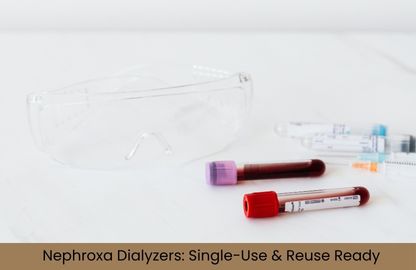
Alternatively, for facilities still supporting reuse dialyzer programs, Nephroxa’s membrane quality and build may allow for multiple treatment cycles without rapid degradation. Reuse-compatible designs require predictable performance across repeated cleanings and Nephroxa may meet those standards.
Ultimately, the decision to reuse or dispose after one session depends on internal hospital policy, patient risk profiles and cost structures. Nephroxa’s ability to accommodate either scenario makes it a versatile choice for varying operational strategies.
How Does the Nephroxa Dialyzer Improve Dialyzer Efficiency in Clinical Settings?
Dialyzer efficiency refers to the device’s ability to achieve maximum solute removal with minimal resource input. It encompasses membrane performance, fluid dynamics and how the device maintains clearance rates throughout a treatment session.
Hospitals switching to Nephroxa are often focused on maintaining consistent solute removal – especially under high blood flow conditions or when treating patients with higher toxin loads.
Key considerations in this efficiency include:
- Membrane permeability: Nephroxa membranes may be engineered to enhance small and medium molecule clearance while reducing unwanted protein loss.
- Flow optimization: Efficient blood and dialysate flow through the unit without excessive resistance or turbulence ensures that the session remains effective from start to finish.
- Durability: A dialyzer that maintains structural integrity and performance over multiple hours or cycles supports higher treatment quality.
The outcome is a treatment that stays within the prescribed parameters without excessive adjustments, alarms or performance drop-offs. Hospitals choosing Nephroxa likely aim to optimize this balance between clinical effectiveness and session stability.
These evaluations typically examine:
- Urea and creatinine clearance rates
- Middle molecule removal efficiency
- Patient tolerance and symptom reduction
- Device failure rates or pressure alarms
- Hemodynamic stability during sessions
Nephroxa dialyzers may perform well in these metrics, giving medical teams confidence in the transition. Furthermore, consistency across patient demographics and treatment modalities can make Nephroxa a dependable component of the hospital’s dialysis program.
Why is There Clinical Validation Behind the Shift to Nephroxa Dialyzers?
Although public comparative trials may be limited, hospitals make data-driven decisions. Internal evaluations, pilot programs and treatment audits help medical teams determine whether a new dialyzer unit delivers expected outcomes.
What Operational Adjustments Are Required When Switching to Nephroxa Dialyzer Units?
Switching to a new dialyzer unit brand like Nephroxa involves more than replacing the device. Hospitals must ensure the infrastructure, staff training and safety systems align with the new equipment.
Some adjustments may include:
- Training: Dialysis staff must learn new setup procedures, priming methods and parameter monitoring techniques.
- Inventory management: Stocking the correct sizes, flux types and compatible accessories requires tight supply chain coordination.
- Quality assurance: Each device must be checked for integrity, labeling accuracy and sterilization validity before patient use.
Hospitals often conduct gradual implementation across units or run parallel comparisons to manage the transition smoothly. The goal is to maintain patient safety and treatment continuity while upgrading the hardware.
Proven Dialysis Solutions. Trusted by Clinics
 WHATSAPP NOW
Why the Switch to Nephroxa Dialyzers Influence Long-Term Outcomes?
Hospitals are focused on long-term metrics that influence patient survival, quality of life and readmission rates. A high-performing dialyzer plays a role in reducing complications from inadequate dialysis, inflammation or vascular stress.
Nephroxa Dialyzers may support:
- Consistent toxin clearance: Sustained removal of waste reduces the buildup of harmful compounds between sessions.
- Stable fluid balance: Reliable ultrafiltration ensures that fluid overload or dehydration complications are minimized.
- Lower inflammation: Improved biocompatibility can lead to reduced immune activation, enhancing patient comfort and reducing complications.
While the dialyzer is only one part of the treatment ecosystem, hospitals recognize its impact. Choosing a brand that aligns with broader care goals – like Nephroxa – can support overall program quality and patient experience.
Why Nephroxa Dialyzers Compatible with Evolving Dialysis Technology?
As dialysis technology evolves, integration becomes a deciding factor in product selection. Hospitals are increasingly implementing systems with digital monitoring, real-time analytics and remote adjustment capabilities.
Nephroxa dialyzers may align with these needs through:
- Modular design: Allowing flexibility in integration with various machines and workflows.
- Data-friendly protocols: Supporting monitoring of pressures, flows and clearances in real time.
- Future-ready materials: Using biocompatible membranes that minimize biofilm formation or clotting risk.
Hospitals looking for scalability and innovation may view Nephroxa as a solution not just for today’s needs, but for long-term dialysis advancements.
In Conclusion
The decision to switch to Nephroxa dialyzer devices reflects a broader movement in hospitals toward streamlined, reliable and high-performing dialysis care. These units may deliver consistent clearance, ease of integration and adaptability to multiple clinical scenarios – from high flux detoxification to single use simplicity or reuse flexibility.
Hospitals are not only seeking better outcomes – they are building systems that prioritize safety, predictability and adaptability. As the demands of dialysis continue to grow, Nephroxa may stand out as a device that supports the next generation of patient care.
FAQs on Nephroxa Dialyzers
Nephroxa dialyzers are engineered for consistent performance, may offer multiple flux types and integrate smoothly with other dialysis consumables, allowing hospitals to simplify workflows.
They may support both, depending on hospital policy and the model used. Single-use offers simplicity, while reuse models require strict sterilization and tracking protocols.
Yes, hospitals may use high flux versions of Nephroxa dialyzers for more effective removal of larger or protein-bound toxins in advanced cases.
With proper training and calibration, most hospitals can integrate Nephroxa into their existing systems with minimal disruption.
Higher efficiency ensures reliable waste removal and fluid balance, which can reduce complications, improve session tolerance and support long-term patient health.



